AI processes conversations the way humans think
AWAI's pipeline is built on a 3-layer context model that structurally aligns with cognitive science. Designed by intuition, validated by research — here's how it works.
Three layers that construct the 'meaning' of thought
Immediate Context
Related information within the current topic. All thought nodes in the same message are referenced without filtering.
Proximal Context
Nodes from 1–2 messages prior. Not everything is pulled in — text similarity filtering ensures only relevant context is considered.
Distant Context
Past nodes with high cosine similarity, regardless of message distance. The "oh, this connects to something I said before" association.
We designed this by asking "how does human memory actually work?" — then discovered that established cognitive science theories describe the same structure. Built from intuition and self-observation, later validated by research.
Designed by intuition, validated by science
| AWAI's Implementation | Cognitive Theory | Proposed by |
|---|---|---|
| Layer 1: Immediate context | Working Memory | Baddeley & Hitch (1974) |
| Layer 2: Proximal context filter | Selective Attention | Broadbent (1958) |
| Layer 3: Distant recall | Cue-dependent Retrieval | Tulving (1983) |
| Distance-unlimited high-similarity recall | Spreading Activation | Collins & Loftus (1975) |
| 2-pass reinterpretation | Memory Reconsolidation | Nader et al. (2000) |
| Processing depth based on prediction error | Predictive Processing | Friston (2005) |
| Unaddressed topic detection | Zeigarnik Effect | Zeigarnik (1927) |
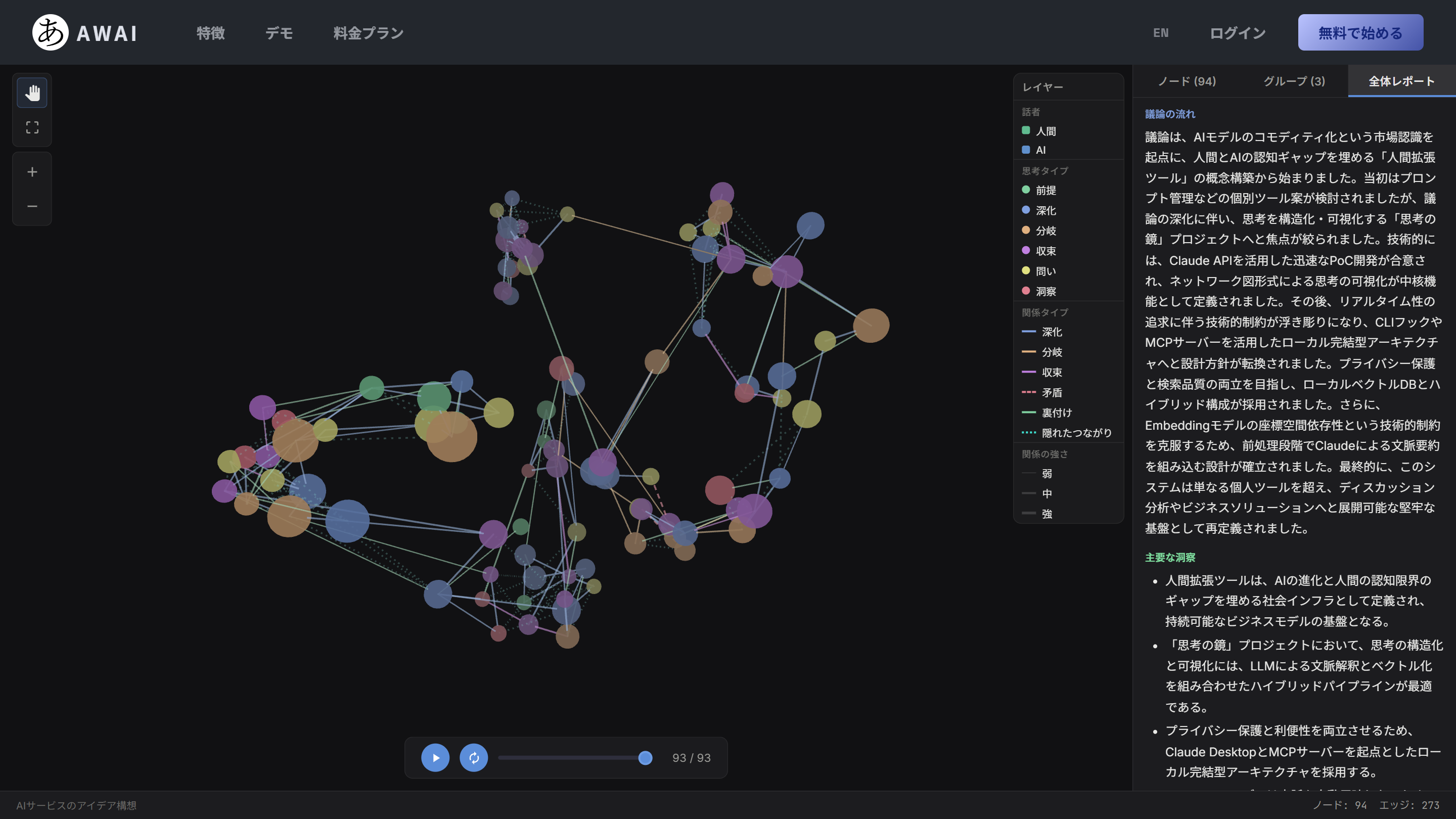
Predict, discover, reinterpret
Naive Interpretation
Using only Layer 1 and Layer 2 local context, generate an initial "straightforward" understanding.
Contextual Reinterpretation
When Layer 3 finds distant context, incorporate it to update the understanding.
Integrative Reinterpretation
Only thoughts whose interpretation changed significantly between Phase 1→2 receive deeper processing.
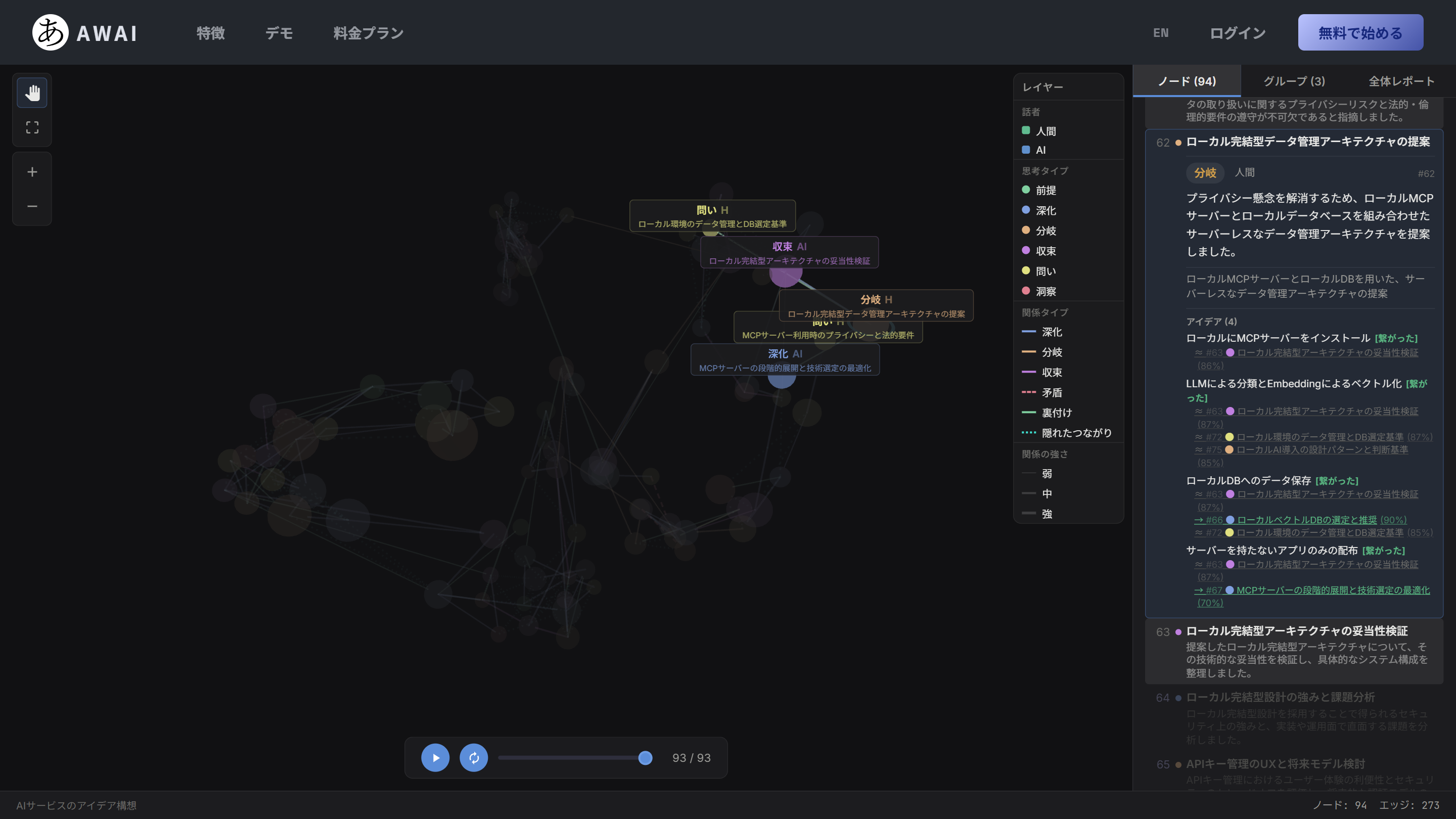
Explicit connections and hidden links
LLM Edges
Relationships the AI explicitly identifies as connected. These are ideas that were actually linked during the conversation.
Embedding Edges
Pairs with high vector similarity. Ideas that are semantically close but were never directly connected in the conversation.
Making invisible connections visible — that's one of AWAI's core values.
Six colors that reveal the nature of thought
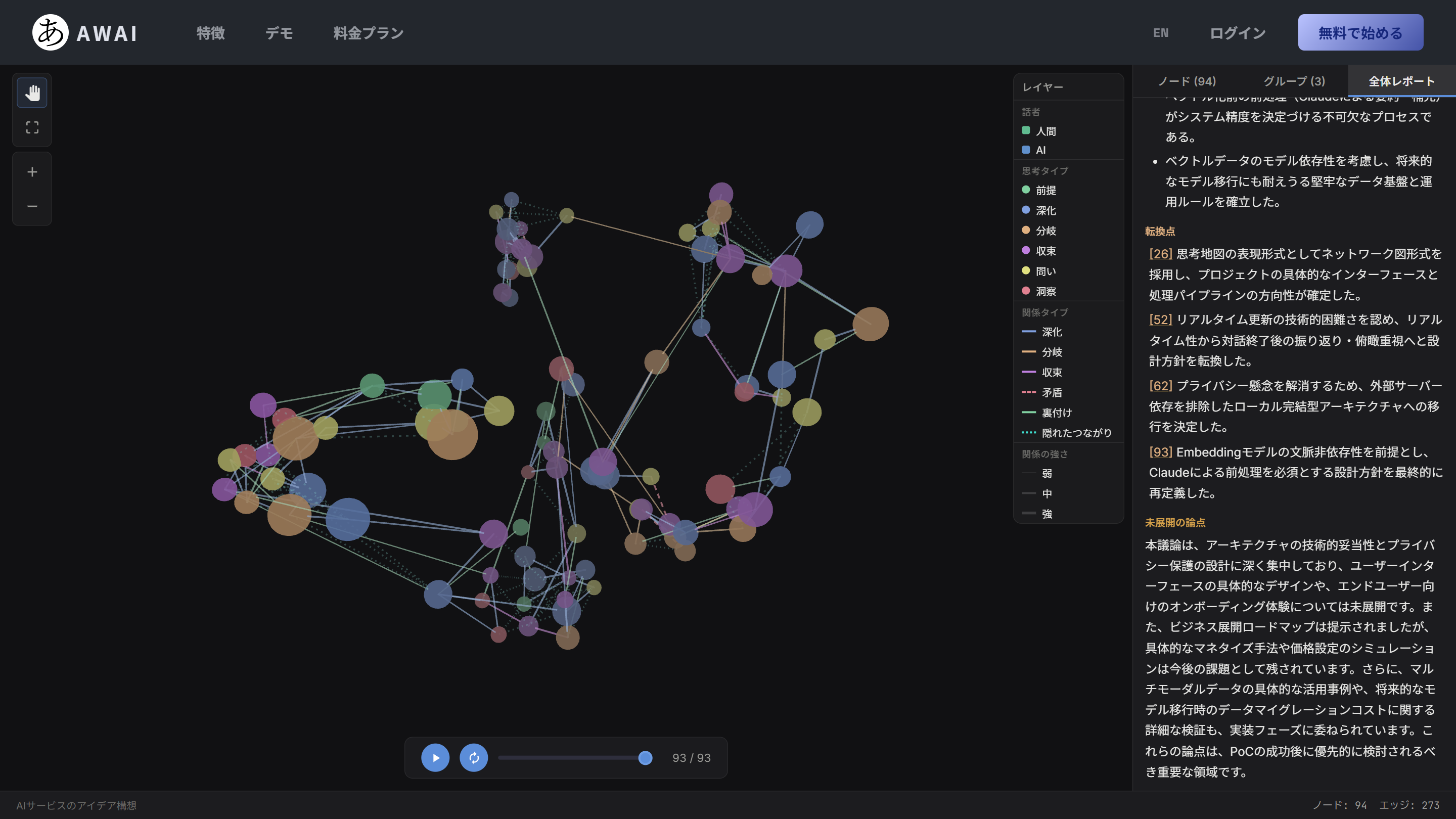
In the space between thoughts, structure emerges.
In the space between minds, shared understanding is born.
"AWAI" is an archaic Japanese reading of "between." In the uncertainty before things are settled, possibility lives — AWAI makes that space visible.